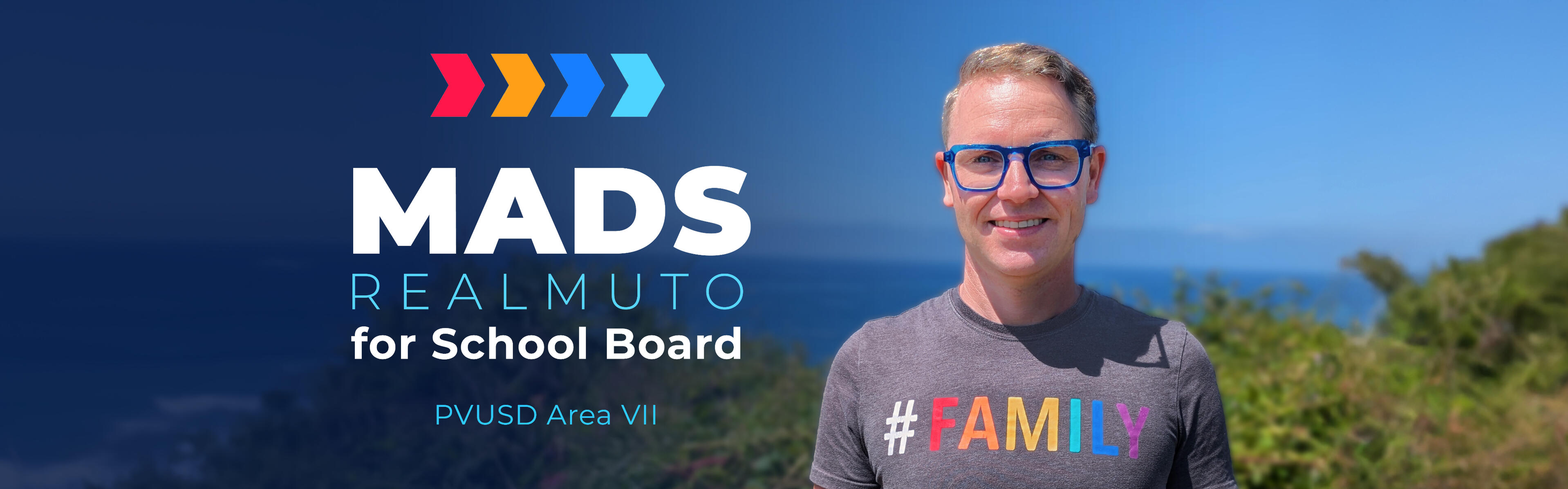
Let's Build Trust.
I believe PVUSD can do better for students, families, teachers, and staff. Too often, major decisions are made with limited visibility into the reasoning behind them, too little consideration of alternatives, and insufficient focus on their impact on students. Trust is built through transparency, thoughtful decision-making, and accountability—not just good intentions.As a parent in this district, I’ve seen both what works and where families struggle to access the support they need. I’ve successfully advocated for my own children and helped other families navigate similar challenges. I’m running to help bring greater urgency, clearer communication, and stronger accountability to our district—while staying relentlessly focused on what matters most: improving outcomes for students.
If elected, four key principles will guide my service as a PVUSD School Board Trustee.

TRANSPARENCY
Clear communication of decisions, tradeoffs, and impacts affecting students, staff, and families.

ACCOUNTABILITY
Setting clear expectations, measuring outcomes, and following through with honesty and responsibility

DATA-INFORMED
Using evidence, outcomes, and community input to guide thoughtful, effective district decision making.

STUDENT CENTERED
Prioritizing decisions that directly improve student learning, support, well-being, and future opportunities.
I believe the role of the board is not to micromanage schools — it is to establish clear goals, strong guardrails, and accountability for results. Click below to learn more.
My Story
I grew up in La Selva Beach, attended Valencia and Aptos Jr., and graduated from Aptos High School. After spending nearly two decades studying and working internationally, I returned home with my husband to raise our family in this wonderful community. We are incredibly fortunate to live among so many amazing natural spaces — from the beach to the redwood forests — and that’s usually where you’ll find me with our kids when I’m not helping coach their soccer team.Professionally, I spent nearly two decades in global public affairs, managing communications and helping shape public policy focused on improving consumer safety. My work centered on translating highly technical issues into clear, actionable policy solutions; experience I believe is directly relevant to school board governance and improving district decision-making. I am also active in PVUSD’s special education community advisory committee and serve on the sustainable schools advisory committee, which is tasked with recommending updated school configurations to reflect our shrinking student population and maximize educational opportunities.As a parent in this district, including raising a child with disabilities, I’ve seen both what works and how hard families often have to fight to get their children what they need. That should concern all of us — because access to support and opportunity should not depend on how many resources, or how much time, knowledge, and advocacy a family can bring. I believe schools should support multiple pathways to success, including strong career and technical education opportunities alongside college preparation, so every student can build a future aligned with their strengths, interests, and goals. I’m running to help bring greater accountability, clearer communication, and stronger public trust to the district — because every student deserves a school system relentlessly committed to their success.
Get Involved
Volunteer | Endorse | Yard Signs | Donate
We'd love to have you with us on the campaign trail. Please click the support link below to contact us, endorse Mads, pledge a donation, sign up to host a meet and greet, canvass, and more. Let's build trust together. Thank you for your support!
Policy Priorities
I believe the role of the board is not to micromanage schools — it is to establish clear goals, strong guardrails, and accountability for results. As a member of the PVUSD Board of Education, I would work to ensure the district vision and values reflect that of our community. I would emphatically advocate for a narrow set of board-level priorities so that we can make meaningful progress on our student outcomes.
1. Reduce the Temperature in the Board Room and Across the District
Improve board effectiveness, stakeholder trust, and constructive community engagement while accelerating timely decision-making and reducing conflict-driven disruption in the first year.Guiding Principles
• Board and district communications will remain respectful, transparent, solutions-oriented, truthful, and focused on student outcomes.
• The board should operate with a sense of urgency and avoid unnecessary delays on critical issues impacting students and families.
• Board discussions should prioritize student outcomes over political or personal conflict.Strategic Focus Area
• Rethink how and when the district, schools, and teachers communicate with families outside the classroom. Reduce excessive, duplicative, or low-value districtwide communication in favor of clearer, more relevant, community-building communication at the local school level.
• Improve transparency around major district decisions, including rationale, tradeoffs, timelines, and expected impacts.
2. Improve Student Achievement
Improve student achievement with a particular focus on math and literacy — essential foundations for critical thinking, communication, and long-term success — while driving measurable year-over-year growth across all student groups.Guiding Principles
• Instructional approaches should prioritize evidence-based literacy and mathematics practices.
• Teachers should receive meaningful support through training, mentorship, instructional aides, and professional collaboration.
• Foundational learning time in reading and math should be protected and prioritized.Strategic Focus Area
• Strengthen early literacy and math intervention systems.
• Expand targeted academic supports and enrichment opportunities.
• Improve data systems that help identify student needs earlier.
• Increase classroom-level support for teachers to improve instructional effectiveness and consistency.
3. Enhance and Expand Career & Technical Pathways
Increase access to and completion of career technical education pathways, internships, certifications, and workforce partnerships; improving student access to living-wage careers, trade programs, and real-world job readiness opportunities following graduation.Guiding Principles
• Career pathways should receive similar respect, visibility, and investment as traditional college-prep routes.
• Programs should prioritize skills and industries aligned with workforce needs in our local communities and future economic trends.
• Students should have access to multiple high-quality pathways to success regardless of whether they pursue a traditional four-year college degree.Strategic Focus Area
• Expand partnerships with local employers, trade groups, community colleges, and apprenticeship programs.
• Increase access to internships, dual-enrollment, certifications, and work-based learning.
• Elevate visibility and recognition of CTE achievement and career readiness pathways.
• Prepare students for a rapidly changing workforce shaped by automation and AI.
4. Create Healthy, Future-Ready Learning Environments
Improve student engagement, focus, communication, socio-emotional development, physical well-being, and holistic educational outcomes by implementing developmentally appropriate technology practices and expanding hands-on, collaborative, and real-world learning opportunities.Guiding Principles
• Technology should serve as a tool (not a substitute) for human interaction, critical thinking, creativity, communication, healthy habits, and active community engagement.
• Schools should help develop students who can learn, collaborate, communicate, and contribute effectively both with and without screens. Any screen-based instructional practices should demonstrate clear, data-backed educational benefits.
• Schools should support the development of healthy, balanced, and resilient students by promoting physical activity, nutrition awareness, interpersonal connection, creativity, civic responsibility, and positive community engagement.
• Educational environments should help students build the life skills, confidence, empathy, and healthy habits necessary to succeed academically, socially, and personally.Strategic Focus Area
• Reduce unnecessary screen dependency and distractions during the school day.
• Expand hands-on, outdoor, arts, collaborative, and project-based learning opportunities.
• Promote healthy habits including physical activity, interpersonal engagement, and balanced technology use.
• Increase student access to sports, enrichment activities, clubs, music, arts, and community-building opportunities.
• Explore opportunities for greater student involvement in healthy food systems, nutrition education, school gardens, culinary pathways, and access to healthier food choices.
• Support socio-emotional development through relationship-building, communication skills, belonging, mentorship, and positive school culture.
• Establish age-appropriate technology expectations and cellphone policies.
5. Ensure Sustainable, Student-Centered District Transformation
Develop and implement a transparent, long-term, financially sustainable district strategy that adapts to enrollment decline and budget realities while improving student outcomes, protecting essential supports, supporting workforce stability, and maintaining equitable access and opportunity for all students.Guiding Principles
• District restructuring, budget reductions, and operational changes should be guided by data, transparency, and measurable student impact.
• No student group should disproportionately bear the burden of district transformation efforts.
• Long-term sustainability efforts should not create avoidable short-term harm to student learning, safety, well-being, or legally required services.
• The district should recognize that maintaining and attracting high-quality teachers and staff requires thoughtful consideration of compensation, working conditions, and workforce stability.Strategic Focus Area
• Address long-standing structural budget and enrollment challenges proactively rather than reactively.
• Improve transparency around financial decisions, tradeoffs, timelines, and long-term planning.
• Align district resources and facilities with long-term enrollment realities and student needs.
• Prioritize investments that directly support student outcomes and classroom effectiveness.
Campaign Launch Party
The Point in Seascape Village | 4-7pm